
Blog
Student-Designed Murals: A Campus Art Program That Refreshes Every Year
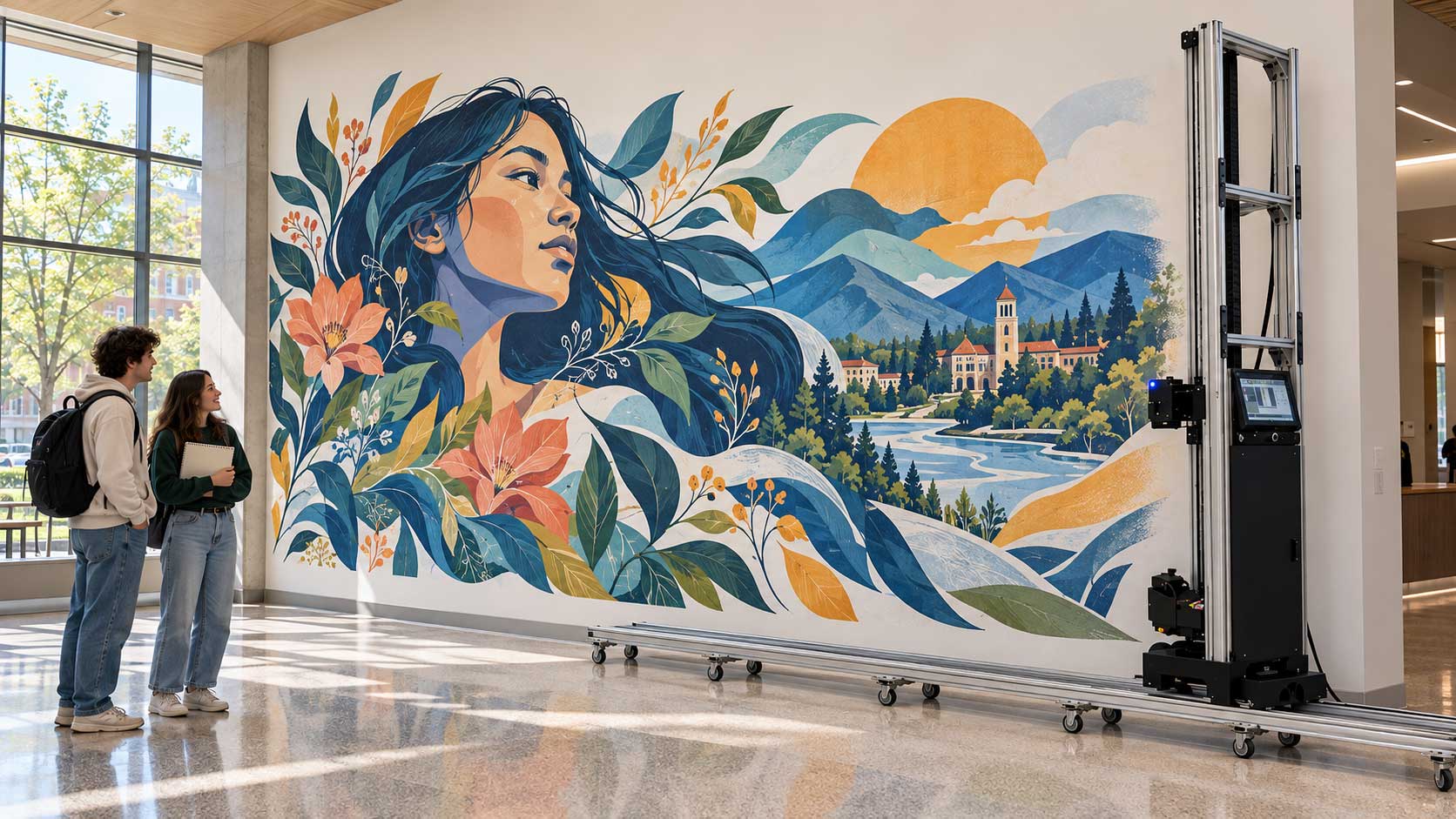
A college art department produces new student work every semester. A wall printer on campus gives selected pieces a place on the walls of the student union, the residence halls, or the arts building, printed at full scale with the artist's name beside them.
One way to run it is as a yearly competition. Students submit designs in the spring, a jury picks the winners, and trained staff print them over the summer, so new student art is up when classes start in the fall. The following year's winners replace them on the same walls.
Choose the walls before the competition opens
Start with facilities. Before the call for entries goes out, the staff who will run the printer should walk each candidate location and confirm three things: they can position and level the machine there, the wall suits repainting and reprinting year after year, and the printable area is clear of the doors, outlets, signs, and fixtures that would break up a design. A wall that passes all three and sits where students walk past it every day is a strong candidate.
A smooth painted wall is the simplest choice for a mural that changes every year. Brick, concrete, wood, glass, and metal can all take a print, but preparation and replacement vary by material, so confirm the method for a specific surface with us before building it into the program. The FAQ covers surfaces in more detail.
The GT3200 prints up to 11 feet tall and stops about a foot below the ceiling, and image width extends along the track. Facilities can combine those limits with the wall survey to set a printable area for each location.
Settle the rules before inviting submissions
Set the eligibility rules, the judging criteria, and the display period first. Say plainly in the call for entries that each mural stays up for one year and then makes way for the next winner, so every entrant knows the arrangement from the start. Decide how to credit artists, whether with a name and class year printed beside the work or a label nearby.
Permission deserves the same care. Before anything prints, get each winner's permission to reproduce the work, and use the institution's approval process to spell out how the college may use it, on the wall and in photos of the wall, and what production changes it may make, such as cropping or color adjustment.
Getting student files ready for a wall
Resolution has to hold up at the finished size. A file labeled 300 DPI can still lack enough detail once it's enlarged to mural size, so check resolution at the final print dimensions. Before submissions open, have the printer operator write file requirements for each wall: accepted formats (the printer's software works with JPEG, PNG, TIFF, and PDF), the resolution needed at final size, and how to handle vector artwork inside a PDF. Students who paint or draw by hand can scan or photograph their work at high resolution and meet the same requirements.
Once the jury picks the winners, run a production review of each file. The artist and a faculty advisor sign off on the final proof, including any cropping or color adjustment, and the operator can print a test section before committing to the full wall.
Summer production and a fall unveiling
Trained facilities, maintenance, or print-shop staff can schedule the work for summer weeks or any quiet stretch in a building. The LED UV lamps cure the ink as it prints, so each section is dry as soon as it's finished. Hold the unveiling during the first week of classes. The artists get to stand next to their work, and incoming students learn about a competition they can enter in the spring.
Next year's refresh
On a painted wall, staff paint over last year's mural with two to three coats, let the new paint cure according to the paint manufacturer's instructions and the printer's surface guidance, and print the new winner on the fresh surface.
A gallery wall suits a college that wants past winners to stay up. Plan the layout from the start with space for future additions, and staff can add each new winner beside earlier ones, subject to alignment on the existing wall. Over several years, the corridor builds into a record of successive winners. Cured ink can last roughly 8 to 10 years indoors and is waterproof.
Who handles each part
The art department runs the competition: the brief, the jury, and the work with students on final files. A trained operator in facilities or the print shop handles production and keeps the printer in good working order between competitions, following the daily, weekly, and long-term maintenance and storage routines covered in training. That training runs two days, hands-on, for up to two people at our Bay Shore demo center, and the original purchaser gets phone and online technical support for the life of the printer.
The rest of the year, the printer can support other wall projects across the campus, from donor recognition walls to department wayfinding.
Watch the printer run in Bay Shore
Come see a print go up on a real wall at our Bay Shore demo center. Bring your art department chair, the staff who would run the machine, and photos and measurements of the walls you're considering, and we can talk through each location. Call 646-870-4000 to schedule a visit, or request a quote online.